
🌱 Vegetarian Protein Chart: Your Simple Guide to Protein-Rich Foods
When we hear the word “protein,” we often think of eggs, chicken or fish. But if you’re vegetarian, don’t worry—you have plenty of protein-rich options available.
From paneer and soy chunks to dals, beans, seeds and even oats, vegetarian foods can contribute significantly to your daily protein intake.
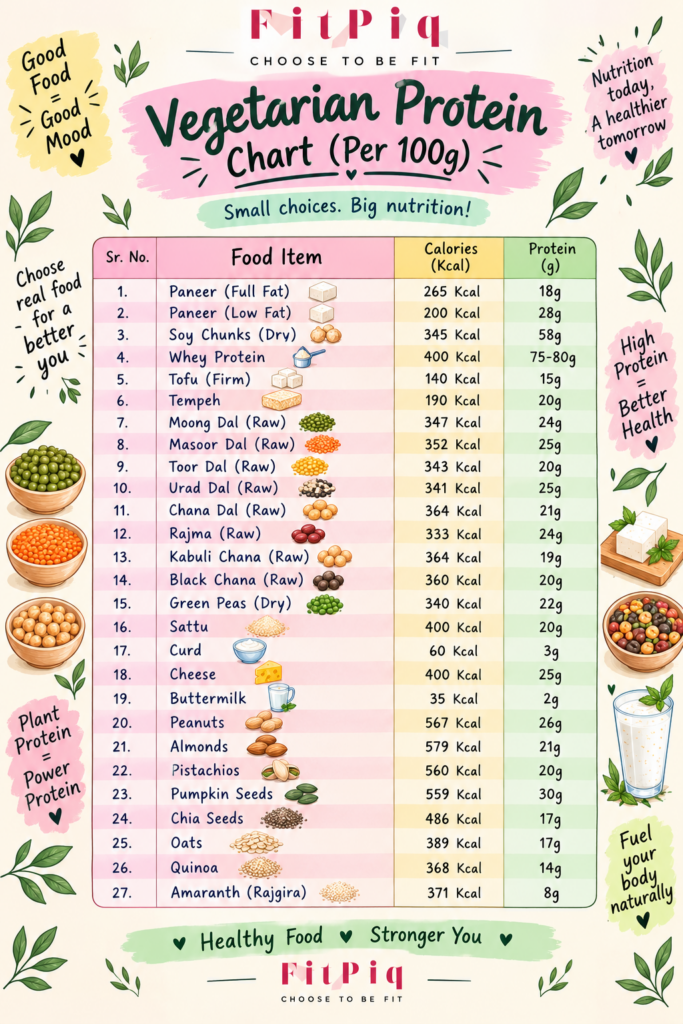
The chart above gives an approximate comparison of calories and protein per 100 g. But remember: some foods are listed in their raw/dry form, while others are ready-to-eat foods. So the numbers should be used as a reference, not as a direct comparison of typical serving sizes.
Let’s go through them one by one. 💚
🧀 1. Paneer (Full Fat)
Approx. 265 kcal | 18 g protein per 100 g
Paneer is one of the most popular vegetarian protein sources in Indian households. It is versatile, delicious and easy to include in almost any meal.
You can enjoy paneer as:
- Paneer bhurji
- Paneer tikka
- Paneer salad
- Paneer wrap
- Paneer cheela
- Paneer curry
Because full-fat paneer is also calorie-dense, portion size matters, especially if your goal is weight management.
🧀 2. Paneer (Low Fat)
Approx. 200 kcal | 28 g protein per 100 g
Low-fat paneer can be a useful option when you want to increase protein while keeping calories relatively lower.
It can be used in exactly the same ways as regular paneer.
👉 Simple idea: Add low-fat paneer to a vegetable stir-fry or salad for a more protein-rich meal.
🌱 3. Soy Chunks (Dry)
Approx. 345 kcal | 58 g protein per 100 g
Soy chunks are one of the most protein-dense vegetarian foods on this list.
They are particularly useful for vegetarians trying to increase their protein intake without relying heavily on dairy.
Try them as:
- Soy keema
- Soy tikki
- Soy pulao
- Soy curry
- Soy salad
- Soy cheela
🥤 4. Whey Protein
Approx. 400 kcal | 75–80 g protein per 100 g
Whey protein is a milk-derived protein supplement and can be suitable for people following a vegetarian diet who consume dairy.
It can be especially convenient when meeting protein requirements through food alone is difficult.
You can add it to:
- Milk
- Smoothies
- Curd
- Oats
- Homemade protein shakes
Remember, whey is a supplement, not a replacement for a balanced diet.
🌱 5. Tofu (Firm)
Approx. 140 kcal | 15 g protein per 100 g
Tofu is made from soybeans and is a fantastic plant-based alternative to paneer.
It is relatively light in calories and can easily absorb the flavours of spices and marinades.
Try:
Tofu + vegetables + Indian spices = quick protein-rich stir-fry.
You can also use tofu in wraps, salads, curries and bhurji.
🌱 6. Tempeh
Approx. 190 kcal | 20 g protein per 100 g
Tempeh is another soy-based food, but unlike tofu, it is made from fermented soybeans.
It has a firmer, more textured consistency and can be grilled, sautéed or added to curries and salads.
If you’re looking for variety beyond paneer and tofu, tempeh is worth trying.
🟢 7. Moong Dal (Raw)
Approx. 347 kcal | 24 g protein per 100 g
Moong dal is an everyday Indian staple and an excellent way to add plant protein to your meals.
It can be used to make:
- Dal
- Moong chilla
- Sprouts
- Khichdi
- Moong dosa
- Salads
💡 Tip: Combine moong dal with vegetables and curd for a balanced meal.
🟠 8. Masoor Dal (Raw)
Approx. 352 kcal | 25 g protein per 100 g
Masoor dal is quick to cook and provides protein along with carbohydrates, fibre and several micronutrients.
It works beautifully in a simple dal with vegetables and roti or rice.
For a protein-rich breakfast, try masoor dal chilla.
🟡 9. Toor Dal (Raw)
Approx. 343 kcal | 20 g protein per 100 g
Toor dal, also known as arhar dal, is a staple in many Indian homes.
The classic combination of:
Dal + roti/rice + sabzi + salad
can make a nutritious and satisfying meal.
Don’t underestimate simple dal—it can make a meaningful contribution to your daily protein intake.
⚫ 10. Urad Dal (Raw)
Approx. 341 kcal | 25 g protein per 100 g
Urad dal is another protein-containing pulse that is especially popular in South Indian cuisine.
It can be used in:
- Idli
- Dosa
- Dal
- Medu vada
- Dal-based chillas
For a healthier everyday option, steamed preparations such as idli can be preferable to deep-fried versions
🟠 11. Chana Dal (Raw)
Approx. 364 kcal | 21 g protein per 100 g
Chana dal is made from split Bengal gram and is a great addition to an Indian vegetarian diet.
Use it for:
- Chana dal
- Chilla
- Dal paratha
- Dal-based snacks
- Soups
It also provides fibre, which can help make meals more satisfying.
🫘 12. Rajma (Raw)
Approx. 333 kcal | 24 g protein per 100 g
Rajma is a classic example of a food that gives you both protein and carbohydrates.
The famous rajma + rice combination can absolutely fit into a balanced diet.
The key is appropriate portions and adding plenty of vegetables or salad to the meal.
⚠️ Always cook rajma thoroughly; raw or undercooked kidney beans can be unsafe.
🫘 13. Kabuli Chana (Raw)
Approx. 364 kcal | 19 g protein per 100 g
Kabuli chana, or chickpeas, are incredibly versatile.
You can make:
- Chole
- Chana salad
- Hummus
- Chana chaat
- Chickpea wraps
For a simple protein-rich snack, combine boiled chickpeas with cucumber, tomato, coriander, lemon and spices.
🖤 14. Black Chana (Raw)
Approx. 360 kcal | 20 g protein per 100 g
Black chana is another nutritious pulse that provides protein, carbohydrates and fibre.
Try it as:
Boiled black chana + vegetables + lemon + spices = easy chana chaat.
It can also be added to salads or used to make curries.
🟢 15. Green Peas (Dry)
Approx. 340 kcal | 22 g protein per 100 g
Dry green peas can contribute a useful amount of plant protein.
They can be incorporated into:
- Peas pulao
- Curries
- Soups
- Chaat
- Vegetable dishes
Remember that fresh/frozen green peas contain much more water, so their nutrition per 100 g will differ from dry peas.
🌾 16. Sattu
Approx. 400 kcal | 20 g protein per 100 g
Sattu is a traditional Indian food made primarily from roasted gram.
It’s affordable, convenient and incredibly versatile.
Try a simple sattu drink:
Sattu + water + lemon + roasted cumin + black salt + coriander
You can also use sattu to make parathas, chillas and savoury fillings.
🥣 17. Curd
Approx. 60 kcal | 3 g protein per 100 g
Curd may not have as much protein per 100 g as soy or paneer, but it can still make a valuable contribution to your daily intake.
Use it as:
- A side with lunch
- Salad dressing
- Raita
- Breakfast accompaniment
- Base for smoothies
💡 Tip: If protein is your priority, compare different curd/Greek yogurt products because protein content can vary considerably.
🧀 18. Cheese
Approx. 400 kcal | 25 g protein per 100 g
Cheese provides protein but is also relatively calorie-dense.
So rather than making cheese your primary protein source, use it as a flavourful addition.
A small amount can make:
- Cheela
- Wraps
- Sandwiches
- Salads
- Vegetable dishes
more enjoyable.
🥛 19. Buttermilk
Approx. 35 kcal | 2 g protein per 100 g
Buttermilk is a light and refreshing dairy option.
It contributes a small amount of protein while also adding fluid to the diet.
Try homemade buttermilk with:
Curd + water + roasted cumin + coriander + black salt.
It makes a refreshing accompaniment to an Indian meal.
🥜 20. Peanuts
Approx. 567 kcal | 26 g protein per 100 g
Peanuts are often called a protein-rich food—and they certainly contain protein.
But they are also high in calories and fat.
Therefore, think of peanuts as a combination of:
Protein + healthy fats + calories
rather than as a pure protein source.
A small serving of roasted peanuts can be a great snack.
🌰 21. Almonds
Approx. 579 kcal | 21 g protein per 100 g
Almonds provide protein, healthy fats, fibre and several micronutrients.
But just like peanuts, they are calorie-dense.
You don’t need 100 g to benefit from them!
A small portion can be added to:
- Oats
- Curd
- Smoothies
- Breakfast
- Homemade trail mix
💚 22. Pistachio
Approx. 560 kcal | 20 g protein per 100 g
Pistachios provide protein along with healthy fats and other nutrients.
They can be a nutritious snack when eaten in an appropriate portion.
Choose plain or lightly roasted pistachios more often than heavily salted versions.
🎃 23. Pumpkin Seeds
Approx. 559 kcal | 30 g protein per 100 g
Pumpkin seeds are one of the higher-protein seeds on the chart.
They also provide healthy fats and minerals.
But remember:
30 g protein per 100 g does NOT mean you need 100 g!
A small sprinkle over:
- Salads
- Curd
- Oats
- Smoothies
- Soups
is enough to add nutrition and crunch.
🌱 24. Chia Seeds
Approx. 486 kcal | 17 g protein per 100 g
Chia seeds are better known for their fibre and omega-3 fatty acid content, but they also contribute protein.
Try adding them to:
- Overnight oats
- Curd
- Smoothies
- Chia pudding
Because they absorb liquid and expand, always consume them with adequate fluids.
🥣 25. Oats
Approx. 389 kcal | 17 g protein per 100 g
Oats are a nutritious grain that can contribute to your protein intake, but they shouldn’t be considered a concentrated protein food.
Make them more balanced by combining them with another protein source.
Example:
Oats + milk/curd + seeds + nuts
or
Savory oats + tofu/paneer + vegetables
This is much more satisfying than plain oats.
🌾 26. Quinoa
Approx. 368 kcal | 14 g protein per 100 g
Quinoa contains more protein than many common grains and also provides fibre and minerals.
You can use it instead of rice in:
- Quinoa pulao
- Quinoa salad
- Buddha bowls
- Khichdi-style meals
For a more protein-rich meal, combine quinoa with chana, dal, tofu or paneer.
🌾 27. Amaranth (Rajgira)
Approx. 371 kcal | 8 g protein per 100 g
Amaranth, or rajgira, is a traditional Indian grain/pseudocereal that can be included in a varied diet.
It can be used to make:
- Rajgira roti
- Rajgira porridge
- Rajgira chilla
- Rajgira ladoo
- Rajgira-based snacks
While its protein number is lower than soy or dals, it still contributes to overall nutrition.
🌟 The Big Lesson: Don’t Chase the Highest Number!
Looking at this chart, it may be tempting to think:
“I should only eat the foods with the highest protein.”
But that’s not how a healthy diet works.
Soy chunks may provide more protein per 100 g than oats, but that doesn’t make soy “better” than oats.
Similarly, pumpkin seeds provide more protein than curd, but curd can still be an excellent addition to a balanced meal.
Every food has a different nutritional role.
Think of your plate like a team:
🌱 Protein source → dal, paneer, tofu, soy, chana
🥦 Vegetables → vitamins, minerals and fibre
🌾 Carbohydrates → energy
🥜 Healthy fats → nuts and seeds
🥣 Dairy/alternatives → additional protein and nutrients
💚 Final Takeaway of Vegetarian Protein Chart
You don’t need complicated foods or expensive ingredients to improve your vegetarian protein intake.
Your everyday Indian kitchen already has plenty of options.
The real goal is to include a protein source in your meals regularly, choose sensible portions, eat a variety of foods and create balanced meals.
And most importantly:
Don’t focus on one food. Focus on your whole day.
A little protein from curd, some from dal, some from paneer or tofu, and some from nuts and seeds can all add up.
Small choices. Big nutrition. Stronger you. 🌱💪